
What You Need to Know About Medical Malpractice Claims
How to prove malpractice requires demonstrating four key elements: a doctor-patient relationship, a breach of the standard of care, a direct link between the breach and your injury, and quantifiable damages. Proving each element requires clear evidence and often testimony from medical professionals.
When medical care in South Florida communities like Hollywood or Miami falls below acceptable standards, the consequences can be devastating. This article focuses on medical malpractice, which happens when a healthcare provider’s failure to meet professional standards results in patient harm. It’s important to know that not every bad outcome is malpractice. A poor result from treatment doesn’t automatically mean negligence occurred.
Proving a claim is complex. You need concrete evidence linking a provider’s actions to your harm. Florida law requires proving your case “by a preponderance of the evidence,” meaning it’s more likely than not that malpractice happened. The process involves strict deadlines and detailed medical analysis.
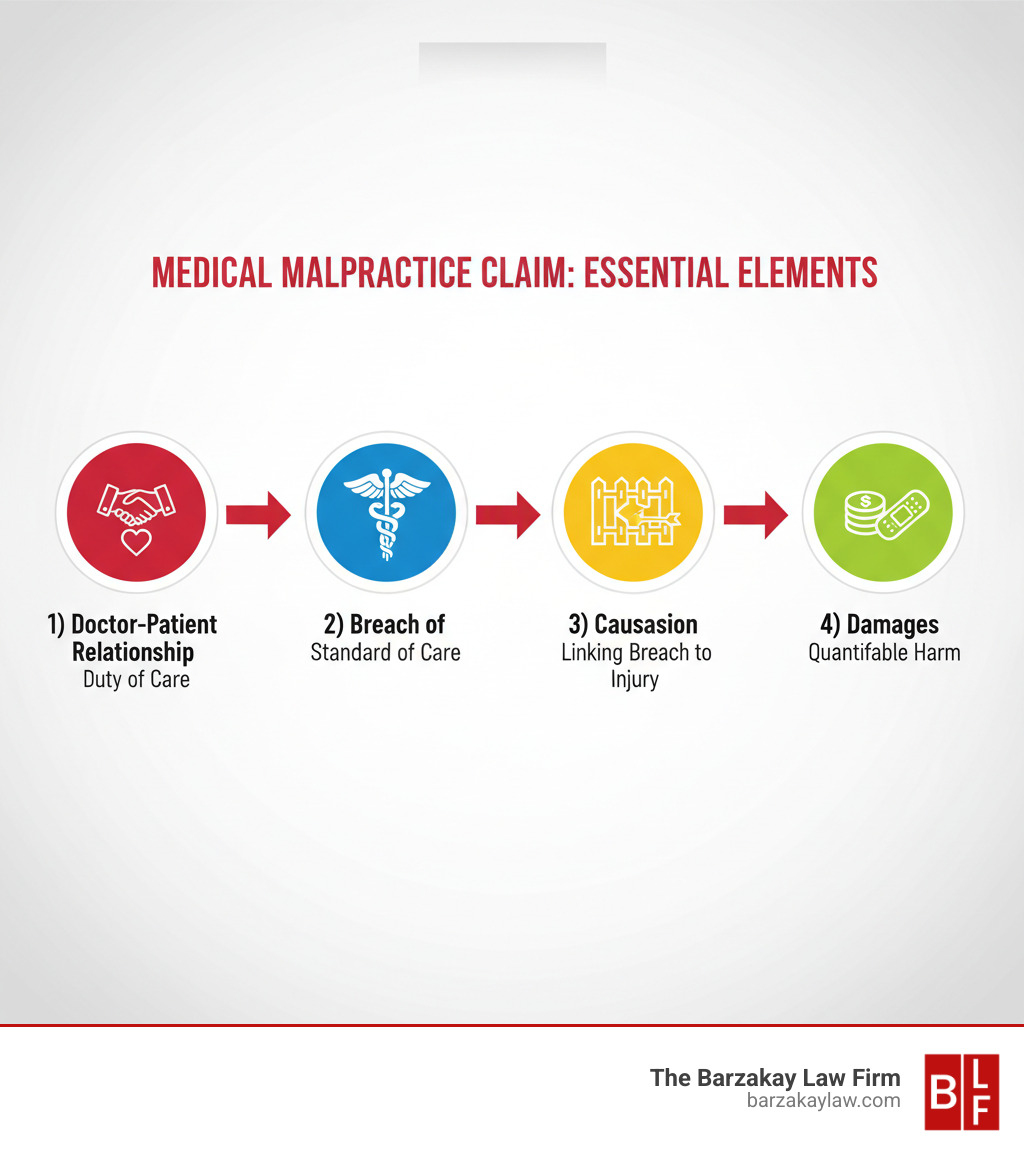
How to Prove Malpractice: The Four Essential Elements
To successfully pursue a medical malpractice claim in Florida, we must establish four critical legal elements. Think of these as the pillars supporting your case; if any one is missing, the structure collapses. These pillars are:
- Duty of Care: A doctor-patient relationship existed.
- Breach of Duty: The healthcare provider failed to meet the accepted standard of care.
- Causation: This breach directly caused your injury or worsened your condition.
- Damages: You suffered quantifiable harm as a result.
Let’s explore each of these in detail.

1. Establishing a Doctor-Patient Relationship (Duty of Care)
Before you can prove malpractice, you must show a professional relationship existed with the healthcare provider. This relationship establishes a legal “duty of care,” obligating the provider to treat you according to accepted medical standards. Without this duty, there can be no breach.
This relationship can be established in several ways:
- Formal Relationship: The most common way is by scheduling an appointment and receiving treatment from a doctor in a location like Hollywood or Miami.
- Implied Relationship: A duty of care can be created even without a formal appointment, such as when a doctor reviews your medical records and provides advice.
- Emergency Room Care: Arriving at an ER in South Florida and receiving treatment automatically establishes a doctor-patient relationship with the attending staff.
- Consultation: A consulting physician who reviews your case and offers guidance to your primary doctor may also owe you a duty of care.
It’s also important to know that providers generally have no duty to strangers. A doctor who witnesses an emergency outside of a medical setting is not automatically obligated to provide care. You cannot sue for malpractice if no duty of care was ever established.
2. Proving a Breach of the Medical Standard of Care
After establishing a duty of care, the next step in how to prove malpractice is showing the provider breached that duty. This means their care fell below the accepted medical standard of care.
Florida statute 766.102 defines this as the level of care that a “reasonably prudent similar health care provider” would have used in the same situation. It’s not about perfection, but about meeting a professional benchmark. This failure to meet the standard is also known as medical negligence. A poor outcome alone is not enough; you must show the provider was negligent.
Common examples of a breach include:
- Misdiagnosis or Delayed Diagnosis: A doctor in Miami or Hollywood fails to identify a serious condition like cancer or heart disease in a timely manner.
- Surgical Errors: Mistakes like operating on the wrong body part or leaving instruments inside a patient. These complex situations are covered in our Surgical Malpractice Lawyer Complete Guide.
- Birth Injuries: Preventable errors during labor and delivery that harm the mother or baby. We handle sensitive cases involving Birth Related Injuries Medical Malpractice.
- Medication Errors: Prescribing the wrong drug or dosage, or failing to check for harmful interactions.
Proving a breach requires more than pointing to a bad result. It typically requires testimony from other medical professionals who can explain the standard of care and how your provider failed to meet it.
3. Linking the Breach to Your Injury (Causation)
Proving how to prove malpractice requires showing the provider’s negligence directly caused your injury or worsened your condition. This is called causation. If the same harm would have occurred even with proper care, the claim will likely fail.
Florida law requires proving two types of causation:
- Actual Cause: This asks, “Would the injury have happened but for the provider’s negligence?” For example, a delayed diagnosis that allows cancer to spread is an actual cause. Our Failure to Diagnose Lawyer guide details this connection.
- Proximate Cause: This relates to foreseeability. The harm must be a natural and direct result of the provider’s actions.
Proving causation is often the most challenging part of a case. Defense attorneys may argue that pre-existing conditions were the true cause of harm, not the provider’s mistake. Other challenges include multiple contributing factors or a delayed manifestation of injury, where harm appears long after the negligent act. Our Medical Misdiagnosis Attorney page discusses these complex issues.
In Florida, you don’t have to prove negligence was the only cause. You must show it was “more likely than not” a significant contributing factor to your worsened condition. A jury may be asked to weigh the evidence and decide if the link between negligence and harm has been proven.
4. Demonstrating Quantifiable Harm (Damages)
The final element in how to prove malpractice is showing you suffered real, measurable harm, known as damages. If a provider in Miami or Hollywood was negligent but you suffered no harm, there is no case.
Florida law recognizes two main types of damages:
- Economic Damages: These are tangible financial losses backed by bills and receipts. They include medical bills for corrective surgeries and ongoing care, lost wages (both past and future), and costs for things like in-home help or home modifications.
- Non-Economic Damages: These compensate for intangible losses that affect your quality of life. This includes pain and suffering, emotional distress, mental anguish, and loss of enjoyment of life. Permanent disfigurement or disability also falls into this category.
| Type of Damage | Description | Examples |
|---|---|---|
| Economic Damages | Quantifiable financial losses directly resulting from the malpractice. | Medical bills, lost wages, future medical care, rehabilitation costs, household services. |
| Non-Economic Damages | Subjective, intangible losses that impact quality of life. | Pain and suffering, emotional distress, mental anguish, loss of enjoyment of life, disfigurement. |
While economic damages are calculated from bills, non-economic damages are more subjective. Documenting how the injury has impacted your daily life, relationships, and mental health is crucial for demonstrating the full extent of your losses and securing fair compensation.
Gathering Evidence and Testimony for Your Claim
Successfully proving medical malpractice requires a meticulous investigation to gather compelling evidence. This process, often called findy or fact-finding, involves obtaining documents and testimony to build a strong case.

How to Prove Malpractice with Evidence
Evidence forms the building blocks of your claim. Key pieces include:
- Medical Records: These are the backbone of your case, including physician notes, test results, and hospital charts. They tell the story of your care and can reveal errors. The role of these documents is vital, as seen in cases handled by a Medical Records Miami Motorcycle Wreck Attorney.
- Medical Bills and Receipts: These directly prove your economic damages.
- Photos and Videos of Injuries: Visual evidence can powerfully demonstrate the extent of your harm.
- Personal Journals: Documenting your daily pain, emotional struggles, and limitations provides a personal account of your non-economic damages.
- Witness Testimony: Statements from family and friends in Boca Raton or elsewhere in South Florida can describe how the injuries have affected your life.
The Critical Role of a Medical Witness
In nearly all Florida malpractice cases, you will need another healthcare professional to testify on your behalf. A medical witness is crucial for several reasons:
- Establish the standard of care: They explain what a reasonably prudent provider would have done.
- Explain complex medical issues: They translate medical jargon into understandable terms for a jury.
- Prove breach and causation: They provide an opinion on how the provider’s actions deviated from the standard and caused your injury.
Finding a qualified medical witness with similar training and experience is a critical part of building your case.
How to Prove Malpractice When Causation is Complex
As discussed, causation is often the hardest element to prove, especially with complex medical situations. Challenges include:
- Multiple Contributing Factors: The defense may blame pre-existing conditions rather than the provider’s negligence.
- Delayed Manifestation of Injury: Harm from a misdiagnosis may not be apparent for months or years. Cases involving a Medical Misdiagnosis Attorney often face these timing issues.
- Conflicting Medical Opinions: The defense will have its own medical witnesses to dispute your claim.
In Florida, the jury often decides causation. The law allows for a finding of liability even if a provider’s negligence was one of several causes, as long as it was a substantial factor. Studies on medical malpractice confirm the difficulties in proving a claim, especially when negligence is not immediately obvious.
Navigating the Legal Process in Florida
Understanding Florida’s specific legal landscape is key to a successful medical malpractice claim. The process involves strict rules and deadlines that differ from other injury claims.

Understanding Florida’s Statute of Limitations
Time is critical. Florida has strict deadlines for filing a lawsuit:
- Two-Year Statute of Limitations: You generally have two years from the date you finded (or should have finded) the injury caused by negligence.
- Four-Year Statute of Repose: With few exceptions, you cannot file a lawsuit more than four years after the actual negligent act occurred, regardless of when you finded the injury.
These overlapping timelines make it crucial to act quickly. Waiting can jeopardize your ability to build a strong case. Our Medical Malpractice Claim Florida Guide provides more detail on these deadlines.
Comparative Fault and Multiple Defendants
Florida uses a “pure comparative negligence” system. If you are found partially at fault for your injuries (e.g., by not following post-op instructions), your compensation will be reduced by your percentage of fault.
Cases in South Florida can also involve multiple defendants, such as a doctor, nurses, and the hospital. We investigate to identify all parties who may share blame. A hospital can be held liable for its employees’ negligence (vicarious liability) or its own failures, such as inadequate staffing. This principle can also apply to other facilities, as seen in cases of Attorney for Nursing Home Neglect.
The Reality of Settlements and Trials
Most medical malpractice cases settle before trial. Trials are expensive, lengthy, and unpredictable for both sides. Insurance companies often prefer to negotiate a settlement to avoid the risk and publicity of a trial.
However, we are always prepared to go to trial if a fair settlement offer is not made. This may happen if the provider denies wrongdoing or the insurance company’s offer is too low. The reality of litigation has also led some doctors to practice defensive medicine, ordering unnecessary tests to protect against potential lawsuits. These broader implications are explored in discussions on the future of medical malpractice law in Florida. Our goal, whether through settlement or trial, is to secure the compensation you need.
Frequently Asked Questions about Proving Malpractice
Here are answers to common questions we hear from families in Miami, Hollywood, and across South Florida.
What if I’m just unhappy with my medical results?
Being unhappy with your results does not automatically mean you have a malpractice case. Medicine is not an exact science, and providers cannot guarantee a perfect outcome. A bad outcome alone is not malpractice. To have a valid claim, you must prove that the provider’s care deviated from the accepted standard and that this deviation directly caused your harm.
Why is proving causation often the most difficult part?
Proving causation is challenging because patients often have pre-existing health issues. Defense attorneys will argue that these conditions, not their client’s actions, caused the harm. The complexity of medicine, where injuries may not appear for months or years, adds another layer of difficulty. Studies on medical malpractice highlight these challenges. We must present clear evidence to show the provider’s negligence was “more likely than not” the cause of your injury.
Do I need a lawyer for a medical malpractice claim?
While not legally required, handling a malpractice claim on your own is extremely difficult. These cases involve complex medical details, strict legal procedures, and significant costs for things like medical witness testimony. Insurance companies have teams of lawyers and vast resources to fight these claims.
At The Barzakay Law Firm, we handle these cases on a contingency fee basis, meaning you pay no fees unless we win your case. We invest the necessary resources to gather evidence, consult with medical witnesses, and steer the legal system, allowing you to focus on your recovery.
Taking the Next Step in Your Malpractice Claim
Proving medical malpractice requires a clear understanding of the four key elements: duty, breach, causation, and damages. As we’ve discussed, each piece must be supported by thorough documentation, medical records, and often, testimony from qualified professionals.
Timing is also critical. Florida’s strict statute of limitations means that waiting too long can prevent you from seeking justice entirely. The challenge of proving a claim is significant, as it involves connecting complex medical facts to legal standards and standing up to well-funded insurance companies.
This is not a battle you should fight alone. At The Barzakay Law Firm, we help people in Hollywood, Miami, Boca Raton, and throughout South Florida who have been harmed by medical negligence. We understand the complexities of these cases and know how to steer Florida’s legal system.
We work on a contingency fee basis, so you pay no legal fees unless we recover compensation for you. This allows us to invest the necessary resources into your case without adding to your financial burden.
If you believe you or a loved one has been a victim of medical malpractice, contact us for a conversation about your case. It costs nothing to learn about your options, but it could be the first step toward the compensation you deserve.