 Skip to content
Why Understanding Your Options Matters After a Slip and Fall
A slip and fall settlement without a lawyer is possible, but it requires a firm grasp of Florida law, diligent evidence collection, and sharp negotiation skills. While you can legally represent yourself, the process has significant risks that could lower your compensation.
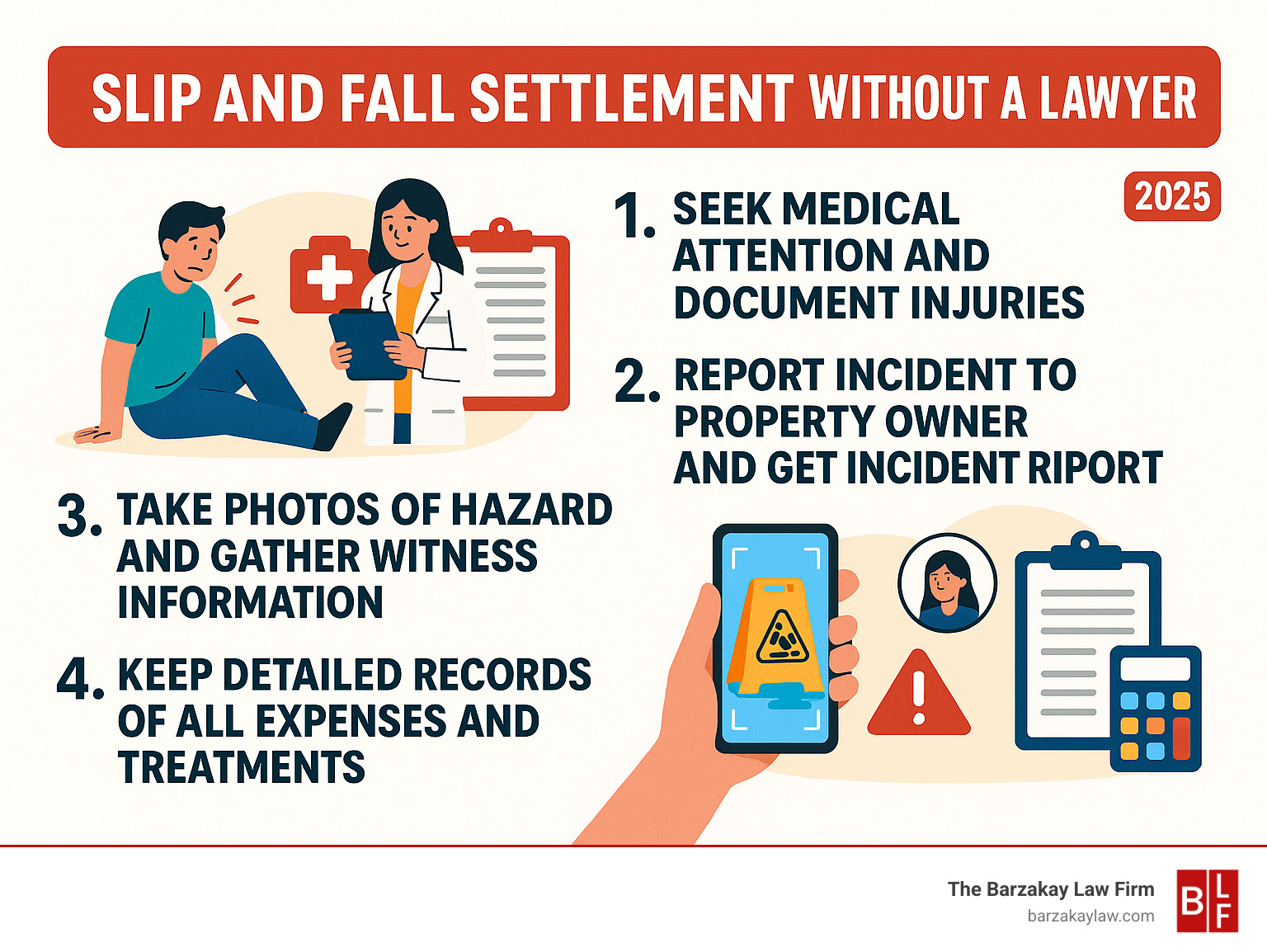
Key Steps for Self-Settlement:
- Document everything – Photos, medical records, witness statements
- Calculate your damages – Medical bills, lost wages, pain and suffering
- File your claim with the property owner’s insurance company
- Negotiate professionally – Present evidence and justify your demand
- Know when to get help – Complex cases often need legal guidance
Insurance companies have teams of adjusters working to minimize payouts. They are well-versed in Florida’s premises liability laws and know that most people don’t understand the full value of their claim. In Florida, slip and fall settlements can range from $10,000 to over $400,000, depending on the case.
While minor injury cases with clear fault may be suitable for self-settlement, severe injuries or disputed liability create complications that can cost you thousands. For residents in Hollywood, Miami, Boca Raton, and throughout South Florida, understanding your options is crucial before deciding. The wrong choice could mean accepting far less than your claim is worth.
Learn more about slip and fall settlement without a lawyer:
- dog bite lawyer Miami
- what does a lawyer caulate a car accident settlement
- what percent of your settlement does lawyer get car accident
Understanding the Pros and Cons of Self-Representation
When facing medical bills after a slip and fall, the idea of keeping your entire settlement is tempting. A slip and fall settlement without a lawyer is legally possible, but it’s important to weigh the pros and cons carefully. You have the right to represent yourself, but it comes with challenges.
According to the American Bar Association (ABA), self-represented litigants can be at a disadvantage. Research shows they often face problems that impact their outcomes. This doesn’t make self-representation impossible, but you must understand what you’re signing up for. For more guidance, see our detailed Slip and Fall Legal Advice.
The Advantages of Handling Your Own Claim
There are some clear benefits to managing your own claim.
- Avoiding legal fees is the primary draw. For straightforward cases with minor injuries, keeping the 30-40% that would go to an attorney can be a significant financial benefit.
- Full control over decisions means you call the shots on settlement offers and strategy without waiting for a lawyer’s input.
- Direct communication with insurers allows you to tell your story in your own words, which some people prefer.
- Personal involvement means you’ll learn about Florida law and the insurance process, which can be empowering.
The Risks of Going It Alone
Now for the reality check that could save you thousands.
- Inexperience with Florida law is a major hurdle. You must prove the property owner knew (or should have known) about a hazard, failed to fix it, and that their negligence caused your injuries. Missing one element can derail your claim.
- Underestimating claim value is a common and costly mistake. An offer might seem generous, but it may not cover future medical care, lost earning capacity, or pain and suffering. Insurers count on you not knowing how to calculate these damages.
- Insurance adjuster tactics are designed to secure quick, low settlements. Adjusters are trained negotiators whose job is to save their company money, not to ensure you get fair compensation.
- Missing deadlines can be fatal to your case. Florida has a two-year statute of limitations for filing a lawsuit, but other critical deadlines exist throughout the claims process.
- Emotional stress from managing a legal case while recovering from an injury can be overwhelming.
For residents in Hollywood, Miami, or Boca Raton, these challenges are the same. The question isn’t if you’re smart enough to handle it, but if the potential savings outweigh the risk of leaving money on the table.
Building Your Case: Evidence and Proving Negligence
Building a slip and fall case requires fitting the right pieces of evidence together to create a clear picture of what happened. When pursuing a slip and fall settlement without a lawyer, you are responsible for collecting this evidence and proving negligence.

The foundation of a successful claim rests on solid evidence and a clear demonstration of negligence. For detailed guidance on Florida’s requirements, our insights on Florida Premises Liability Slip Fall Attorneys can help.
Crucial Evidence You Must Collect
The moments after a fall are critical for gathering evidence.
- Photographs: Take pictures of the hazard, the surrounding area, your injuries, and your clothing from multiple angles. These images freeze the scene in time.
- Witness Information: Get contact details from anyone who saw the fall or the dangerous condition. A witness statement can be invaluable.
- Incident Report: If you fall in a business, insist on an incident report and get a copy. This document proves the incident occurred on their property.
- Medical Documentation: Seek immediate medical attention. This creates a record linking your injuries to the fall. Keep all bills, receipts, and records.
- Lost Wage Documentation: Collect pay stubs and a letter from your employer confirming missed time and lost income.
- Security Footage: Ask about security cameras immediately, as footage is often erased quickly.
How to Prove Negligence in Florida
It’s not enough to prove you fell; you must prove the property owner’s negligence caused your injury. This requires establishing four key elements:
- Duty of Care: The property owner had a responsibility to keep their premises reasonably safe for visitors (like customers in a Boca Raton store).
- Breach of Duty: The owner failed in that duty. They knew or should have known about a hazard (like a spill or broken step) and did nothing to fix it or warn people.
- Causation: The owner’s failure directly caused your injury. The broken step is the reason you fell and broke your wrist.
- Damages: You suffered actual losses, such as medical bills, lost wages, and pain and suffering.
For example, slipping on a grape that was on a Miami store floor for hours is a strong case for negligence. However, if the grape was dropped seconds before you fell, proving negligence is much harder because the store had no reasonable opportunity to clean it up. Understanding these elements is key to building your claim.
Calculating Your Claim’s Worth in Florida
How much is your slip and fall settlement without a lawyer actually worth? Calculating a claim’s value is complex, as settlements in Florida vary dramatically based on the specifics of each case.
Key factors include injury severity, current and future medical expenses, lost income, and the extent of your pain and suffering. The property owner’s insurance limits can also cap your recovery. Additionally, Florida’s comparative negligence law can reduce your compensation if you are found partially at fault for the fall.
| Injury Severity | Medical Costs | Recovery Time | Impact on Life | Typical Settlement Range |
|---|---|---|---|---|
| Minor | Low | Short | Minimal | $10,000 – $50,000 |
| Moderate | Medium | Medium | Noticeable | $50,000 – $150,000 |
| Severe | High | Long/Permanent | Significant | $150,000 – $400,000+ |
For more detailed insights, explore our guide on Slip and Fall Injury Claim.
Typical Settlement Ranges for Slip and Fall Injuries
These are general ranges and your case may differ.
- Minor injuries (sprains, bruises) might settle for $10,000 to $50,000. This can cover medical bills and compensate for the pain and inconvenience.
- Moderate injuries (fractures, torn ligaments) often require surgery and lengthy rehabilitation. Settlements typically range from $50,000 to $150,000.
- Severe injuries (spinal cord damage, traumatic brain injuries) can alter your life permanently. These cases often settle for $150,000 or more, sometimes exceeding $400,000. The average settlement in Florida is between $15,000 and $45,000, but this includes the full spectrum of injuries.
Factoring in Pain, Suffering, and Future Costs
This is where self-representation becomes challenging. Beyond obvious costs, you must account for non-economic damages.
- Pain and suffering covers the physical pain and emotional toll of the injury, like sleepless nights or missing family activities.
- Future medical care includes costs for potential future surgeries, physical therapy, or treatment for chronic conditions like arthritis that develop because of the injury.
- Diminished quality of life compensates for the loss of enjoyment in activities you can no longer do, whether it’s a hobby or daily tasks.
- Emotional distress like anxiety, depression, or PTSD can accompany serious injuries and is a real, compensable loss.
Insurance adjusters are trained to minimize these non-economic damages. Without legal guidance, many people significantly undervalue this portion of their claim, which is often the largest part of a settlement.
Navigating the Process for a Slip and Fall Settlement Without a Lawyer
If you’ve decided to represent yourself, you must steer the settlement process step-by-step. The journey from incident to a slip and fall settlement without a lawyer requires careful organization and persistence.

Key Steps in the Legal Process for a slip and fall settlement without a lawyer
- File an Insurance Claim: Contact the property owner’s insurance company to report the incident. Provide basic details about the fall and your injuries.
- Gather Documentation: Organize all your evidence into a comprehensive package, including medical records, bills, proof of lost wages, witness statements, and photos.
- Write a Demand Letter: This formal document outlines what happened, explains why their insured is at fault, details your injuries and losses, and states your desired settlement amount.
- Negotiate: The insurer’s initial offer will likely be low. This begins the negotiation process. Be prepared for back-and-forth communication.
- Finalize the Settlement: If you reach an agreement, you will sign a release form. Read it carefully, as signing it prevents you from seeking more money later.
Florida gives you two years from the fall date to settle or file a lawsuit. Missing this deadline will end your case.
Negotiating with Insurance Adjusters for Your slip and fall settlement without a lawyer
Negotiating with a trained insurance adjuster can be intimidating, but your personal knowledge of the injury’s impact is a powerful tool.
- Stay Professional: Keep your cool, even with low offers. Emotion can hurt your case.
- Present Evidence Clearly: Organize your documentation logically to support your claim.
- Justify Every Dollar: Explain how you arrived at your settlement demand, connecting specific costs and impacts to your request.
- Never Accept the First Offer: It is almost always a lowball figure designed to test you. Politely decline and explain why it’s insufficient.
- Know Your Bottom Line: Decide on the minimum amount you will accept before negotiations begin. This prevents you from settling for too little in the heat of the moment.
Red Flags: When to Reconsider and Seek Legal Help
Sometimes, pursuing a slip and fall settlement without a lawyer is not the right path. It’s crucial to recognize when a case becomes too complex for a do-it-yourself approach.
Research shows self-represented litigants may lose what would have been a winning case, not because they aren’t capable, but because the legal system is complex and insurance companies have vast resources. If you see any of the following red flags, it’s time to consider seeking legal help.
- Severe Injuries: If you suffered broken bones, a head injury, spinal damage, or required surgery, your case is likely worth far more than you realize. The financial stakes are too high to handle alone.
- Disputed Liability: If the property owner claims you were at fault, you’re in a legal battle. Fighting these allegations requires a deep understanding of Florida’s comparative negligence laws.
- Unresponsive Insurers or Lowball Offers: These are tactics used to wear you down. An insurer might ignore you or make insulting offers, betting you’ll give up or accept a fraction of your claim’s value.
- Large Corporations: If you fell at a major retailer or restaurant chain in Miami or Hollywood, you’re facing a company with a dedicated legal team whose job is to minimize payouts.
- Government Entities: A fall on city or county property in a place like Boca Raton involves special rules and much shorter deadlines that can easily be missed.
For more information about legal representation costs, see our guide on Slip and Fall Lawyer Fees.
Signs Your Case Is Too Complex to Handle Alone
Certain situations almost always require professional guidance. These include cases involving permanent disability, wrongful death, or where multiple parties might be at fault (e.g., a property owner and a maintenance company). If the insurance company alleges you are 100% at fault, overcoming this denial requires a compelling legal argument. Many personal injury attorneys work on a contingency fee basis, meaning you pay nothing unless they win, removing the financial risk of getting help.
Frequently Asked Questions about Self-Settling a Slip and Fall Claim
Here are answers to some of the most common questions people have when considering a slip and fall settlement without a lawyer.
How much does a typical slip and fall case settle for in Florida?
There is no single “typical” amount, as settlements depend heavily on the specifics of the case. However, we can provide general ranges:
- Minor injuries (sprains, bruises) often settle for $10,000 to $50,000.
- Moderate injuries (fractures, concussions) typically fall in the $50,000 to $150,000 range.
- Severe injuries (spinal damage, traumatic brain injury) can result in settlements exceeding $200,000.
The average settlement in Florida is often cited as being between $15,000 and $45,000, but this figure includes the full spectrum of cases. Your final settlement will depend on the severity of your injury, the clarity of the property owner’s fault, and the strength of your evidence.
What is the biggest mistake to avoid when negotiating a settlement?
The biggest mistake is accepting the first offer from the insurance company. This initial offer is almost never their final one. It’s a tactic to see if you’ll accept a quick, low payout.
These offers rarely account for future medical needs, lost earning potential, or the full extent of your pain and suffering. They are designed to close the case cheaply. Be patient, stand firm, and negotiate for a fair amount based on your documented damages.
How long do I have to file a slip and fall claim in Florida?
This is a critical deadline. In Florida, you generally have two years from the date of your accident to either settle your claim or file a lawsuit.
This is a strict statute of limitations. If you miss this deadline, you lose your right to seek compensation, no matter how strong your case is. The two years can pass quickly while you are recovering and negotiating, so it’s important to act promptly.
Conclusion
Pursuing a slip and fall settlement without a lawyer can work for minor, straightforward cases where liability is clear and the insurer is cooperative. You can save on legal fees and maintain full control.
However, the path is filled with potential pitfalls. Florida’s premises liability laws are complex, and insurance adjusters are trained to pay as little as possible. The biggest risk for self-represented claimants is under-settling your claim. Accepting a $25,000 offer might feel like a win, but not if your case was actually worth $75,000. That’s money you may need for future medical care or to cover lost income.
Severe injuries, disputed fault, or cases against large corporations introduce complexities that are difficult to manage alone. When the stakes are high, the risk of making a costly mistake increases dramatically.
If you’re in Hollywood, Miami, or anywhere in South Florida and feel overwhelmed, getting a professional opinion is a wise step. A consultation can help you understand your case’s true value and avoid common errors.
The Barzakay Law Firm can review the details of your situation at no upfront cost. We work on a contingency fee basis, so we only get paid if we win your case. Whether you’re in Boca Raton or Fort Lauderdale, you deserve to know your options and protect your financial recovery.
Contact a personal injury attorney in Hollywood for a case evaluation. We’re here to help you understand your rights and pursue fair compensation.
